In this guide
- What does a Basque coast day actually look like?
- Where do the hours really go?
- Why does the headland have to come first?
- How long do you need in Bermeo?
- Is Mundaka worth a long stop?
- What do you see at Gernika?
- What is the wine tasting actually like?
- Does the order ever change?
- What should you drop if the day is short?
- Is Bakio worth stopping for?
- Where does lunch fit?
- Does the plan change with the season?
- How much time does Gernika deserve?
- Can you build this day with a hire car?
- Does anyone run the loop the other way?
- What should you carry for a full coast day?
What does a Basque coast day actually look like?
The standard loop out of Bilbao runs west to east: the headland first, then the fishing port, then the surf town, then inland to Gernika. Some versions add a winery on the Bakio slopes at the end. The order is not arbitrary — it is built around getting the climb done before the coast fills up.
A full version takes ten hours. A trimmed version takes six. Both give you roughly two hours at the islet, which is the number that matters most, and the difference is how many towns you see afterwards.
Where do the hours really go?
| Time | Where | What happens |
|---|---|---|
| 09:00 | Bilbao | Meet by the Guggenheim, board, drive out |
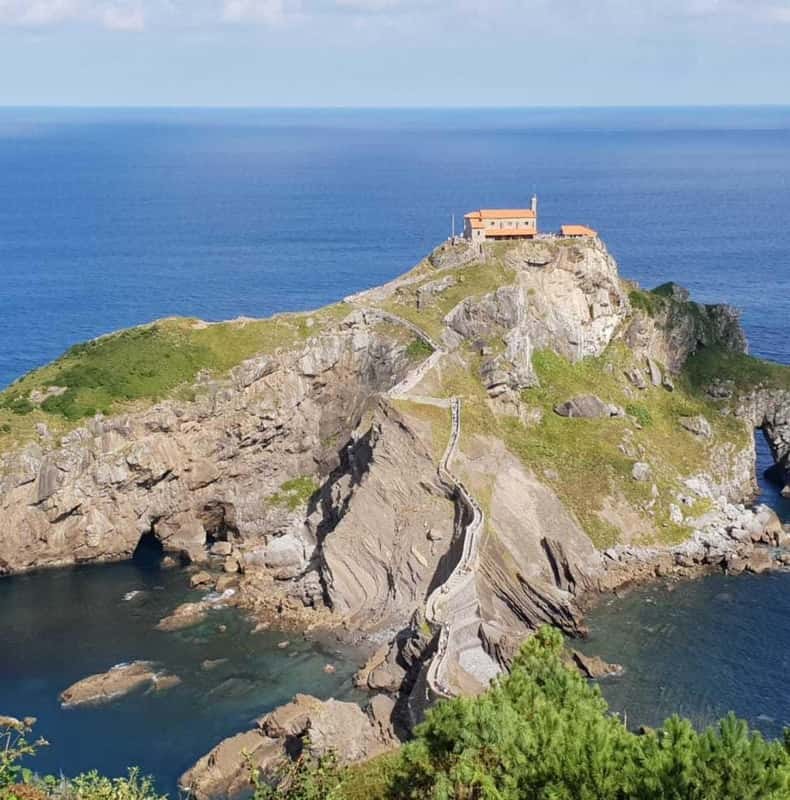
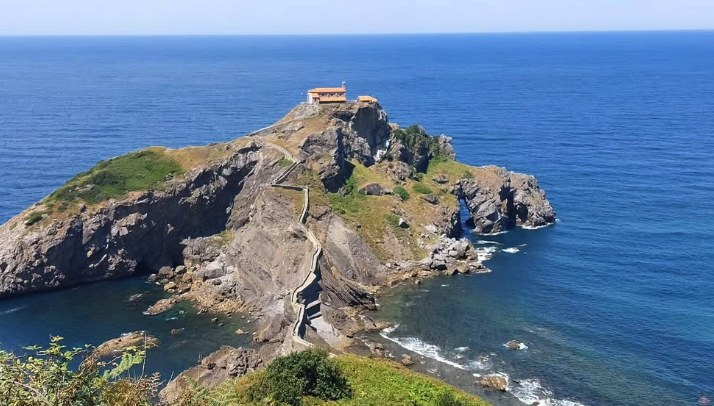
| 09:45 | The ridge | Walk down, 1.1 km, signed at 25 minutes |
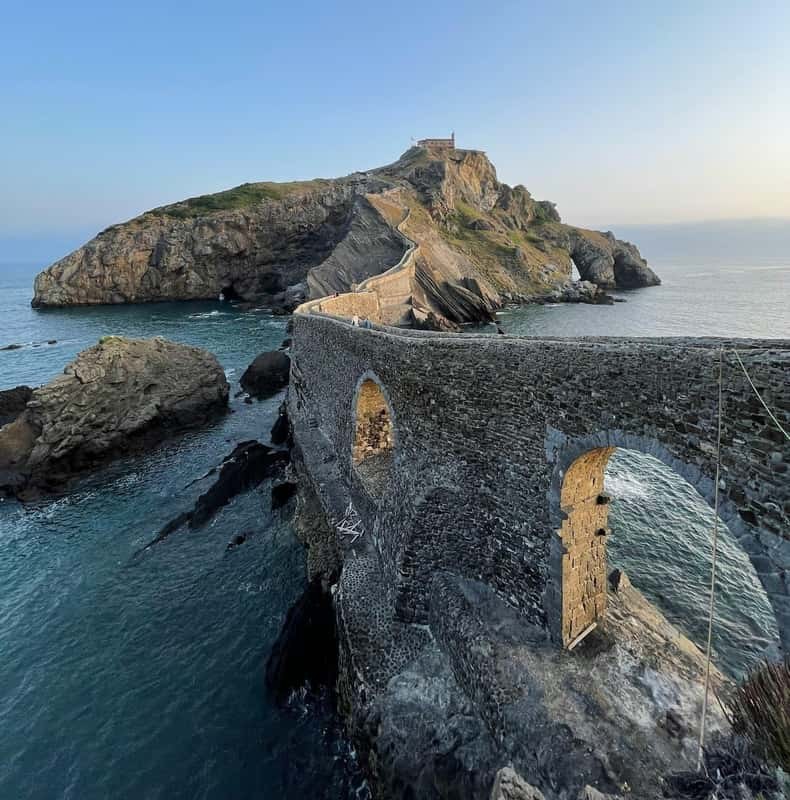
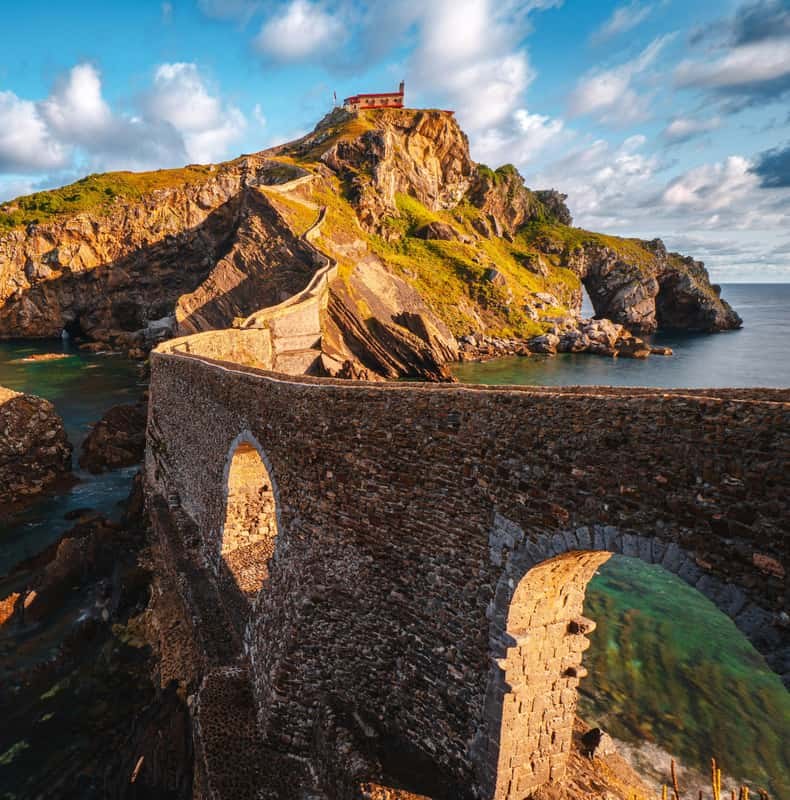
| 10:15 | The bridge | 241 steps, the hermitage, the bell |
| 11:45 | Back at the road | The return climb, and a drink |
| 12:30 | Bermeo | Guided walk through the working harbour |
| 13:30 | Mundaka | Free time and lunch at the estuary mouth |
| 15:45 | Gernika | The Assembly House, the Tree, the mural |
| 17:30 | Bakio slopes | Txakoli tasting at a hillside winery |
| 19:00 | Bilbao | Dropped back where you started |
Those timings are the ten-hour version. The six-hour version keeps the islet and two stops and skips the rest. The 241 steps are the same either way — only the hours after them change.
Why does the headland have to come first?
Three reasons, and they compound. The staircase is quietest in the first hours, before the independent traffic arrives and the coaches converge. The light comes across the rock rather than down onto it, which is why the early photographs look better. And in summer the return climb is bearable at ten and punishing at two.
There is a fourth, less obvious reason. Doing the hardest thing first means the rest of the day is a reward rather than an obligation, and a group that has already climbed is a much happier group in a wine cellar at five o'clock.
How long do you need in Bermeo?
Forty minutes is enough for the harbour, and that is what most trips allow. Bermeo is a working port rather than a preserved one: the nets are stacked on the quay, the fleet goes out, and the terraced houses above the inner harbour are painted because people live in them.
What it gives the day is contrast. After an hour and a half on an exposed rock, a sheltered harbour with a coffee in it lands very well. The things to do page covers what to look for.
Is Mundaka worth a long stop?
It gets the longest stop on most itineraries, usually because it is where lunch happens rather than because the town needs two hours. That said, it earns them. The sandbar at the mouth of the estuary produces a long left-breaking wave that surfers travel from other continents to ride, and the church terrace above the harbour is one of the better views on this coast.
On a flat day it is simply a very pretty town with good seafood. Either way, this is the stop where the day slows down.
What do you see at Gernika?
The Assembly House, the oak that stands beside it, and a tiled reproduction of the painting that carries the town's name. Guided visits run 45 minutes to three hours depending on the trip, and this is the stop where a guide earns their fee outright.
It is also the stop that changes the register of the day. Everything before it is landscape; Gernika is history, and it is the part people talk about afterwards.
What is the wine tasting actually like?
Txakoli is the sharp, faintly sparkling white made on the hills behind Bakio, picked young and poured from a height to open it up. A tasting on the ten-hour trip means a hillside winery, a view back down to the coast you have just spent the day on, and a glass or two with something to eat.
It is included on one trip and not on the others. Whether it is worth four extra hours of day is a personal question, but it is the most memorable ending available.
Does the order ever change?
Yes, and the operators say so. The timed slot allocated for the headland is set by the authorities rather than the tour company, so a group given a later slot will run the itinerary in a different sequence. That sometimes puts the winery before lunch rather than after.
It is not a fault and it does not shorten the day. It is worth knowing so that a rearranged running order reads as normal rather than as something going wrong.
What should you drop if the day is short?
| Day length | Keep | Drop |
|---|---|---|
| 3.5 hours | The islet | Everything else |
| 6 hours | The islet, one town, Gernika | The port, the winery |
| 8 hours | The islet, Gernika at length | The coastal towns |
| 10 hours | Everything | Nothing |
The islet is the one thing that never gets dropped, and Gernika is the one worth keeping after it. The coastal towns are lovely and they are also the most replaceable part of the loop.
Is Bakio worth stopping for?
Most itineraries pass it. Bakio is the wide sand bay immediately west of the headland, with the txakoli slopes rising behind it, and the first proper view of the islet on the drive out comes from that road. On a guided day it is usually a window rather than a stop.
Under your own steam it is worth an hour. The beach is long and swimmable, the town is unpretentious, and the vineyard road behind it is one of the better short drives in Bizkaia. The one trip that includes a tasting takes you up onto those slopes, which is as close as a guided day gets to giving Bakio its due.
Where does lunch fit?
Almost never in the price. Food is excluded on nearly every trip on this coast, and the free time in Mundaka is where the operators expect you to eat. That is a reasonable arrangement: the seafood on that harbour is better than any packed arrangement would be.
The exceptions are the two trips that include a pintxos lunch, one of them private and one capped at seven. Both cost more, and both remove the one moment in the day when a group scatters. The questions page lists what each trip covers.
Does the plan change with the season?
The shape holds all year; the pressure on it does not. In July and August the ridge car parks fill by mid-morning and the staircase carries two-way traffic from ten o'clock onwards, so the early start stops being a preference and becomes the whole strategy.
Out of season the loop relaxes. Winter weekdays often need no reservation at all, the towns are quiet, and the light on the coast is better than anything August produces. What you lose is daylight: a ten-hour itinerary in December finishes in the dark, which takes the edge off the final stop.
Spring and early autumn are the sweet spot, with settled weather and no capacity crush. The month-by-month guide goes through the year properly.
How much time does Gernika deserve?
More than most itineraries give it. Forty-five minutes covers the Assembly House and the oak at a walk; three hours, which one trip from San Sebastian allows, lets the town land properly. The difference is between seeing a monument and understanding why it is one.
If Basque history is the reason you came to this region rather than the coastline, weight your choice towards the trips that allow longer there, even at the cost of a coastal stop. The headland is spectacular and self-explanatory. Gernika is neither, and it repays the guide.
Can you build this day with a hire car?
Comfortably, and it is a good drive. The whole loop is under 80 km, the roads are quiet outside August, and you can spend as long as you like in any of it.
What you take on is the slot, the parking and the timing, in that order of difficulty. The slot is easy if you book early and impossible if you leave it to the morning. The parking on the ridge fills before eleven in summer. The timing matters because a slot missed is a slot gone, and there is no desk to appeal to.
One genuine advantage of driving is the winery. A tasting is the one part of the guided loop that a self-drive day cannot replicate, for obvious reasons, so plan the wine for a different afternoon.
The getting-there guide compares driving against taking a trip, and the access page covers booking the permit yourself.
Does anyone run the loop the other way?
Rarely, and there is a reason. Starting inland at Gernika and finishing at the headland puts the climb at the hottest, busiest part of the day, and it hands the timed slot problem to the end of the itinerary where any delay compounds.
The one situation where a later arrival works is out of season, when capacity control is off and the late-afternoon light on the west flank of the rock is the best of the day. That is a self-drive plan rather than a guided one.
What should you carry for a full coast day?
A day that starts with a staircase and ends in a wine cellar asks for a little planning. The climb comes first and everything else follows it, so pack for the climb and let the rest look after itself.
- Shoes: the single most repeated piece of advice on every listing.
- Water: nothing to buy between the roadside and the summit.
- Wind layer: the summit is exposed in every month.
- Spare shirt: for the return climb in summer.
- Cash: useful in the smaller harbour bars.
- ID: some operators ask for it at booking.
Leave the umbrella behind. The wind on this coast destroys them, and a light waterproof does the job without the argument.