In this guide
- When is the best time to visit Gaztelugatxe?
- What is each month actually like?
- Is high summer worth it?
- Can you visit in winter?
- Why do the shoulder seasons win?
- What does the weather actually do here?
- How often does wind close the climb?
- Can you swim, and when?
- When does the headland photograph best?
- How does the crowd build through the day?
- Does the time of day matter more than the month?
- How does daylight affect the longer trips?
- Does anything close seasonally?
- What should you wear in each season?
- Is there anything happening on the coast?
- What does the sea do through the year?
- How far ahead should you book?
- So when should you book?
When is the best time to visit Gaztelugatxe?
Late May to mid-June, and mid-September to mid-October. Both give you settled weather, long daylight and a headland that is busy rather than overwhelmed. High summer is spectacular and crowded; deep winter is empty and unreliable.
Whatever month you pick, the time of day matters more than the season. The first slot of the morning is quieter, cooler and better lit in every month of the year.
What is each month actually like?
| Month | Weather | Crowds | Permit |
|---|---|---|---|
| January to March | Wet, windy, dramatic | Very quiet | Often not needed |
| April | Changeable, greening | Building at weekends | Weekends |
| May | Mild and settling | Busy at weekends | Weekends |
| June | Warm, long days | Busy from mid-month | Daily from mid-June |
| July and August | Warm, hazy, hot on the climb | Peak | Daily |
| September | Warm, clearer light | Easing after mid-month | Weekends and holidays |
| October | Mild, best colour | Quiet midweek | Weekends and holidays |
| November and December | Wet and blustery | Very quiet | Often not needed |
Permit windows are set by the provincial council and they shift, so check the exact date you want on the access and climb page rather than working from this table alone.
Is high summer worth it?
The coast is at its best-looking and the sea is swimmable, so yes, with two caveats. The climb is genuinely hot: the return leg up 1.1 km of open path in the middle of the afternoon is the single most common complaint in reviews written in August.
And the capacity cap bites. Slots go weeks ahead, the ridge car parks fill before midday, and the staircase carries two-way traffic all day. The answer to both is the same: take the earliest departure available.
Can you visit in winter?
Often more easily than in summer. Capacity control usually lifts on winter weekdays, which means no reservation at all, and the staircase can be close to empty. The light on the folded rock in low winter sun is better than anything August produces.
What you trade is reliability. Wind warnings are commoner, and a warning closes the climb. Short daylight also compresses the longer coast itineraries. Book something with free cancellation and watch the forecast the evening before.
Why do the shoulder seasons win?
Because they solve both problems at once. Late spring and early autumn give you settled weather without the capacity crush, daylight long enough for a ten-hour itinerary, and towns that are open and staffed rather than shuttered.
- Late May to mid-June: green, mild, permits at weekends only.
- Mid-September to mid-October: warm sea, clear air, thinning crowds.
- Both: the wine harvest sits at the end of the second window.
What does the weather actually do here?
This is the Bay of Biscay, not the Mediterranean. Weather arrives from the Atlantic, changes quickly, and rains in every month. Summers are warm rather than hot, winters are mild rather than cold, and wind is a constant.
Rain is not the obstacle people expect. The steps drain, the crowds thin, and the sea looks better for it. Wind is the one that matters, because it closes the climb.
How often does wind close the climb?
Not often, and unpredictably. When the coast is under a wind or storm warning the route onto the islet shuts, and that decision sits with the authorities rather than with any operator.
Can you swim, and when?
Not at the islet itself, where the water is deep, cold and unprotected. Bakio, ten minutes west, is the answer: a long sand bay with a proper beach, lifeguards in season and enough surf to be interesting without being difficult.
The Cantabrian Sea warms slowly and peaks in late August and early September, which is part of why that window is the best of the summer here rather than July. If a swim is part of the plan, take a self-drive day or a trip that finishes early enough to leave you the afternoon.
When does the headland photograph best?
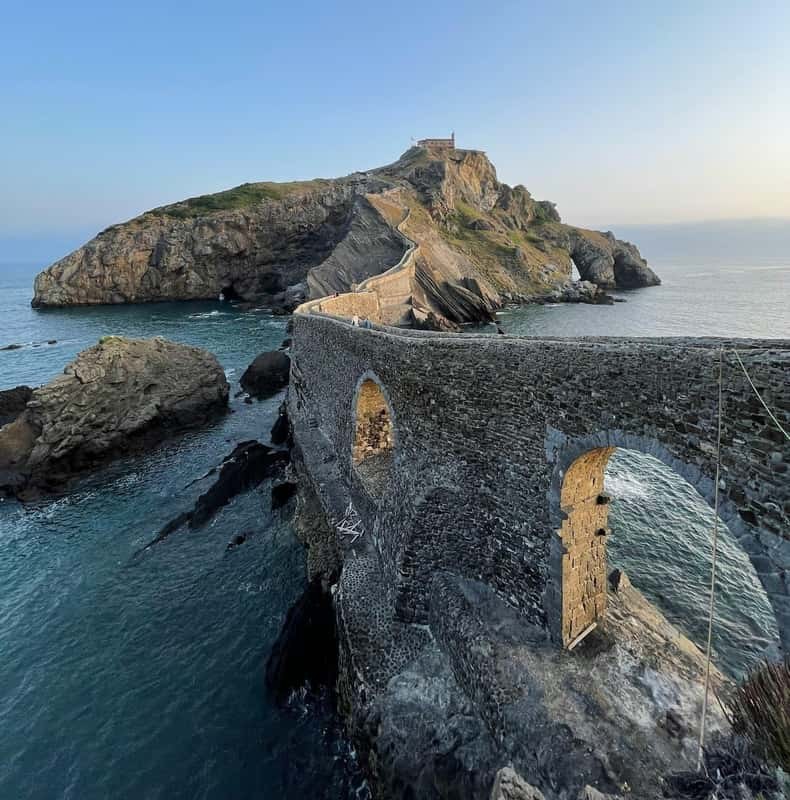
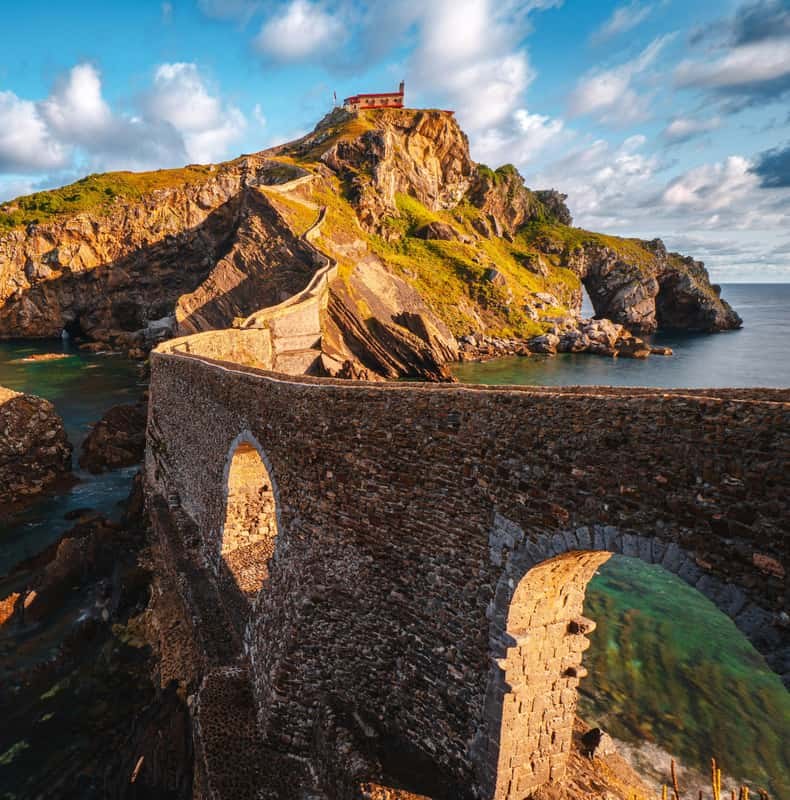
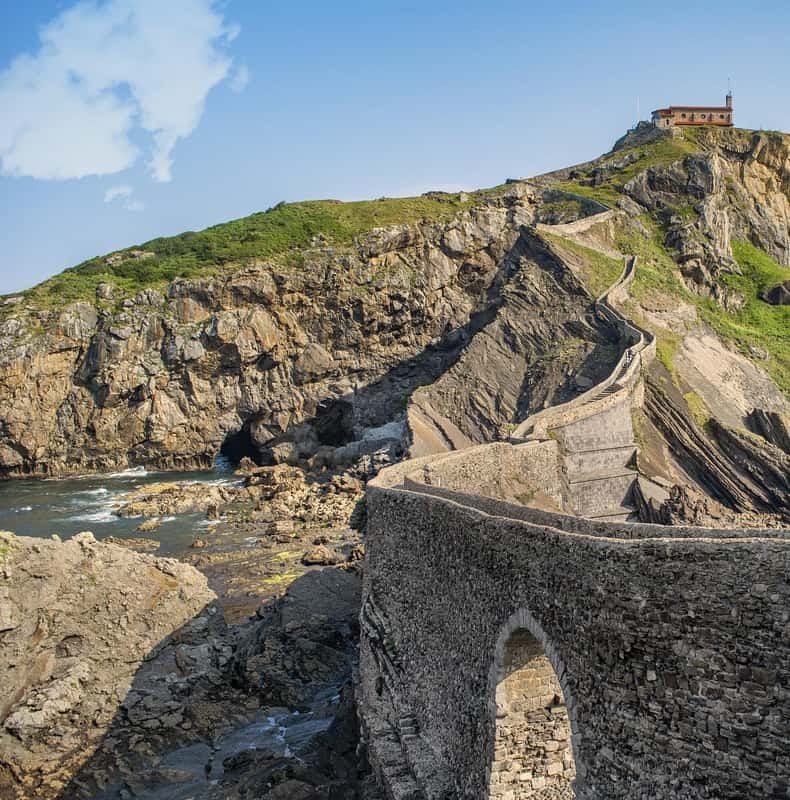
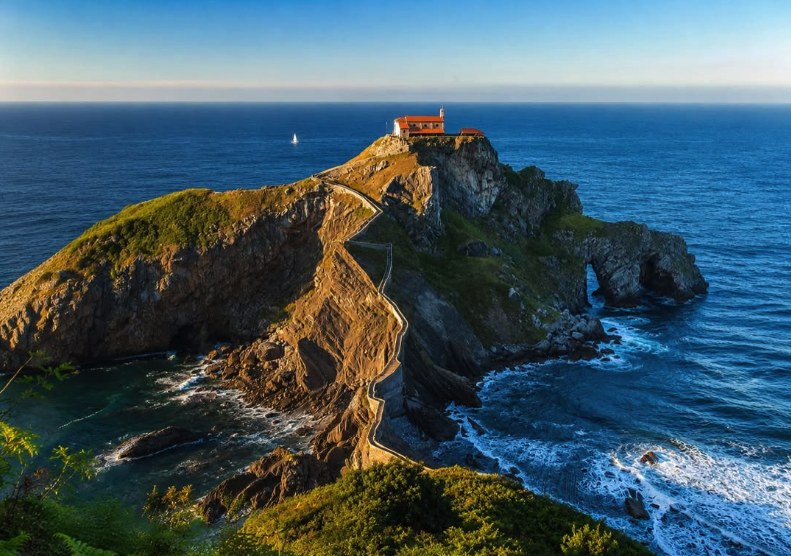
Early morning in any month, and late afternoon in winter. The islet faces roughly north, so the sun crosses it rather than sitting behind it, and the folded rock strata need side light to read at all. Midday flattens the whole thing.
- First light: the classic ridge view, empty staircase, long shadows.
- Mid-morning: good on the bridge looking up, poor from the ridge.
- Midday: flat light and the busiest staircase of the day.
- Late afternoon: warm light on the west flank, best from October to March.
The gallery has the headland in several of those conditions, and the Dragonstone page covers the angles the cameras used.
How does the crowd build through the day?
Predictably, which is what makes it manageable. Independent visitors arrive after breakfast and the coaches from Bilbao reach the ridge at around ten, so the pressure builds sharply between ten and eleven and stays high until mid-afternoon.
| Time | The path | The staircase |
|---|---|---|
| Before 09:30 | Almost empty | Almost empty |
| 09:30 to 11:00 | Filling | Steady two-way traffic |
| 11:00 to 15:00 | Busy | Queues at the turns in August |
| After 16:00 | Thinning | Quiet again |
The late-afternoon window is real and under-used, though it works better outside the capacity-control months when a slot is not required.
Does the time of day matter more than the month?
Yes, and it is not close. The first slot of the day is quieter in January and in August alike, the light runs across the rock rather than down onto it, and in summer you climb before the heat.
Trips leaving Bilbao around nine reach the headland inside exactly that window. It is the practical reason the photographers standing on the steps at nine in the morning almost all arrived on a coach.
How does daylight affect the longer trips?
A ten-hour itinerary leaving at nine gets back around seven in the evening. In June that is full daylight; in December it finishes after dark, which takes the edge off the final stop and the drive back.
Between November and February the shorter trips make more sense: a three-and-a-half-hour walk or a six-hour half day both finish in the light. The coast day plan shows what each length covers.
Does anything close seasonally?
The hermitage building itself opens on a limited schedule that varies with the season and with public holidays, so treat the interior as a bonus rather than the plan. The terrace, the bell and the views are what the climb reliably delivers.
The coastal towns are quieter out of season, with fewer places open in Mundaka and Bermeo midweek in January. Gernika and the Assembly House keep going year round. The things to do page covers each stop.
What should you wear in each season?
| Season | On the feet | On top | Also |
|---|---|---|---|
| Spring | Grippy trainers | Light waterproof | Layers |
| Summer | Walking shoes | Sun cover | Extra water, spare shirt |
| Autumn | Walking shoes | Windproof | Early finish |
| Winter | Grip matters most | Proper waterproof | Gloves for the handrails |
Leave the umbrella in every season. The wind here destroys them, and a hood keeps your hands free for the handrails, which matters more on wet stone than any amount of waterproof fabric does. Gloves are worth carrying between November and March for the same reason: the metal rail on the exposed flights is genuinely cold in winter, and warm hands grip far better than cold ones.
Is there anything happening on the coast?
The Basque calendar is dense, and two things touch this coast directly. The last Sunday of July brings the pilgrimage to the hermitage, when locals climb the steps in numbers and the day belongs to them rather than to visitors. And late September into October is the txakoli harvest on the Bakio slopes, which is when a tasting stop is at its best.
Neither closes anything. Both change the character of the day, and both are worth building towards rather than around.
What does the sea do through the year?
It rises. Winter Atlantic swell hits this coast hard, which is exactly why Mundaka draws surfers between October and March and why the water below the bridge looks nothing like its summer self. Spray reaches the lower steps on the biggest days.
Summer flattens it out. The green shelf on the sheltered side of the bridge is at its clearest in July and August, and the sea stack offshore sits in glass. Both versions are worth seeing; only one of them photographs the way the postcards do.
How far ahead should you book?
| Travelling in | Book the trip | Book the permit yourself |
|---|---|---|
| December to March | A few days ahead | Often unnecessary |
| April and May | A week or two | Weekends, a week ahead |
| June to September | Three to four weeks | Several weeks |
| October and November | A week or two | Weekends, a week ahead |
Because every trip cancels free up to 24 hours before departure, booking early costs nothing and protects the departure time you want. In August the early slots are what sell out first, and they are the ones worth having.
So when should you book?
Aim for the second half of May, the first half of June, or the four weeks from mid-September. Take the earliest departure of the day whatever month you choose. Book far enough ahead that you are not pushed onto a later slot, and pick something that cancels free so a wind warning is a decision rather than a loss.
If your dates are fixed and they land in August, none of this is a reason not to go. It is a reason to be on the first coach out of the city. compare every Gaztelugatxe tour on departure time as well as price.